
“ And what will you do with your tremendous talent after you resign?”
This is what my business head said, rather irritated and tired after I told her that I wanted to resign from a job that I had barely started two months back.
I was working for a little more than two years after my MBA. This was my second job and I landed myself in a challenging environment. Let’s just say my peers and immediate manager could do with some “inclusion and sense of belonging” coaching. A mature me would have handled the situation in a different way, but the younger me had little patience.
So one morning, when one of my peers commented on my work with sarcasm and bossiness, I rushed to the business head (who had hired me) to render my resignation. Her response was firm and terse:
“You want to quit? And what will you do with your tremendous talent after you resign? You translate ideas into words like no other. You are congenial and easy to work with. But wanting everyone to like you is simply wrong expectation. You young people don’t appreciate opportunities that can develop your foundations. You’ve worked hard for this position and now you are throwing it away. What for? To be liked?”
Something about her strict and frank response made me stay.
After more than a decade of this incidence, I am now in a place where I feel like giving the same feedback to many people who work in my team. My irritation and tiredness at their readiness to resign at the drop of a hat is nothing less that that of my business head all those years back. I am not alone. According to a Forbes article, 45% of the hiring managers interviewed found Gen Z’s careers the worst to manage.
Imagine this:
- Your talented Gen Z employee resigns saying, “you culture sucks” in as many words. Or
- They come up to you after working for 6 month and ask straight up, “how can I get your job?” Or
- Their mom calls you to give you tips on how to work with them in office.
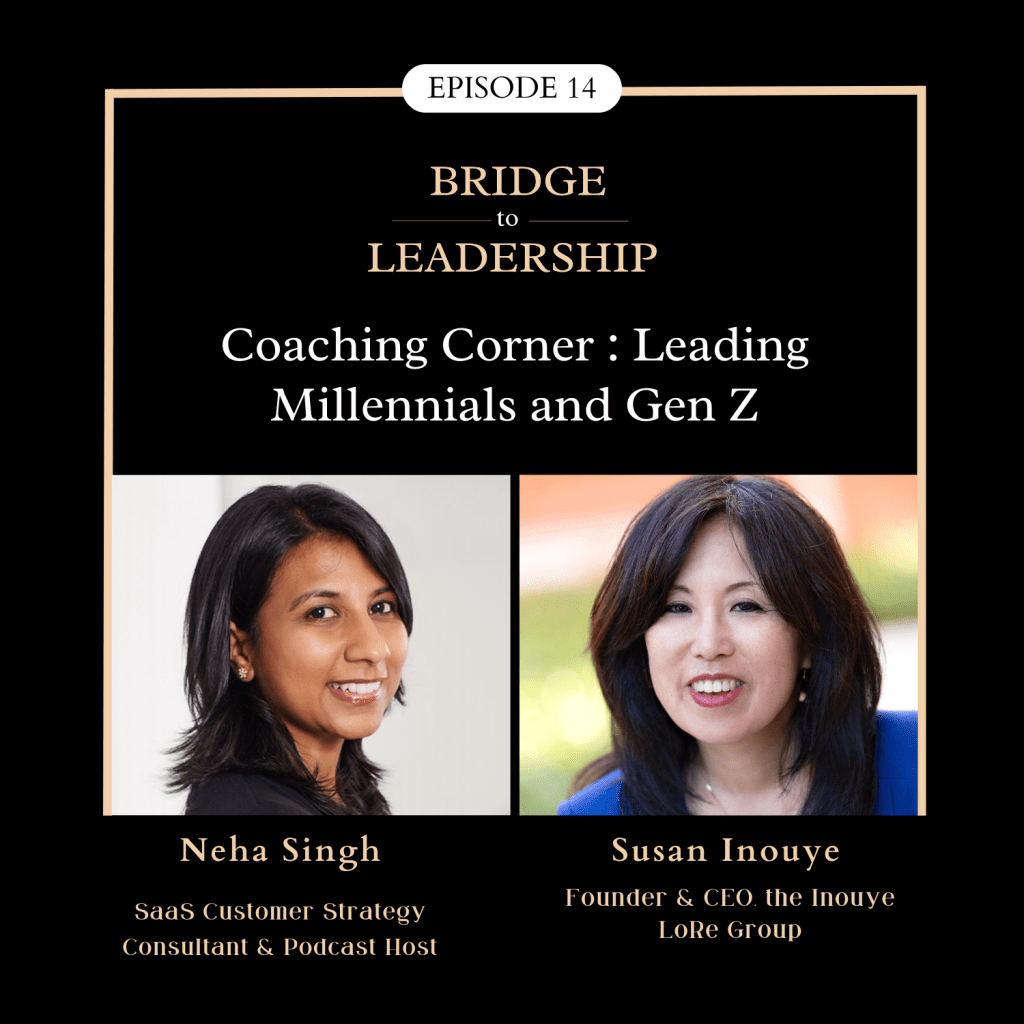
None of the above are hypothetical examples. Susan Inouye, seasoned executive coach and a recognised expert in working with millennials and Gen Z, shared the above with me when I asked her what frustrated her clients about Millennials and Gen Z.
So why have millennials and Gen Z caused such a ruckus? Why do managers struggle to get this generation to bring their best selves to work and be engaged?
According to Susan, they have three requirements:
- They want to feel heard
- They want to use their gifts
- They want to have meaning and purpose in life.
Aren’t these desires that we all cherish irrespective of the generation we belong to? How are millennials and Get Z different?
The difference is that millennials and Gen Z are demanding it more than their predecessors. Why?
- Millennials and Gen Z have been brought up to follow their passions unlike their predecessors who prioritised getting a secure job and paying bills.
- Second, they grew up in the information age. Information used to be a tool for the powerful to retain authority. Now it’s available to everyone at click of a button. Millennials and Gen Z question authority like no other. A designation and tenure is not enough to make them defer to you.
- They live in the age of social media. They know they have a voice. They won’t shy away from using it.
- This generation witnessed economic downturn. They saw their parents laid off. They harbour a legitimate scepticism towards established corporate order.
So how does a leader cater to these needs without getting overwhelmed by their “my way or the high way” attitude?
Susan Inouye found answer to this in an unexpected place – a non-profit organisation called Youth Mentoring Connection (YMC) that works with inner city youth in Los Angeles, California. YMC has worked with millennials for over 15 years and its methods have transformed the lives of at risk youth in over 30 countries. Their approach is called “Sawubona Leadership.”
Sawubona Leadership is not based on academic theory. It didn’t emerge to create a consulting concept positioned as ground breaking advice. It emerged to turn around the life of at risk youth. A cohort that won’t recognise authority and look for innovative ways to break rules.
So what is Sawubona Leadership?
Unlike other leadership approaches that tell you how to get employees to be their best self, Sawubona Leadership starts by recognising that people already are their best self. Sawubona leaders see each person as intrinsically gifted in the way that they are; they develop the whole person and create the opportunities and culture for each to live up their highest potential.”
“The Essence of Sawubona Leadership is found in a Zulu greeting and reply:
Sawubona – I see you
Yebo Sawubona – I see you seeing me
Sawubona is an invitation to a deep witnessing and mutual presence – an intention to see each other for our gifts and our purpose in the world.” – Susan Inouye in Leadership’s Perfect Storm
What does it mean in action?
It means that a carrot and stick approach is no longer effective in getting employees to perform and deliver results. Millennials and Gen Z demand that their whole person be acknowledged and addressed. In order to do that leaders need to “connect” with their employees. Connection doesn’t mean “communication” or “connectivity”. Connection means how your employees feel in your presence. To connect, a leader needs to look for their employees gifts in every situation, even when they are so called “acting up.”
Let’s look at how my business head connected with me when I was ready to throw in the towel:
- She started by recognising my gifts in the midst of her irritation and my tantrum – my ability to bring ideas to life through my writing and being easy to work with. This recognition connected me with her.
- After this, she highlighted my blind spot – My misplaced expectations and lack of resilience. I was congenial and expected everyone to be the same. When I didn’t get the reciprocation, I was ready to quit instead of ignoring the noise and focussing on developing my gifts.
Because she genuinely appreciated me, I connected with her. When I connected with her, I was open to receiving some constructive feedback. It was that connection, that made me stay back and do my best. Had she started with highlighting my blind spots, no matter how true and accurate, the conversation would have gone in a different direction.
There was nothing touchy feely about our conversation. It was straight, no nonsense, strict and to the point. But at no point was it carrot and stick. She appreciated who I was, not what I was doing. She wasn’t punishing me for my errors. She was highlighting areas of development by talking about my blind spots.
“A boss who uses the language of gifts will know how to make course corrections without making the learner defensive.” – Susan Inouye in Leadership’s Perfect Storm
In order to develop the whole person, a leader needs to equip herself to deal with not just the gifts and passions of her employees but also problems and blind spots. All this while holding them accountable to high standards.
Leading millennials and Gen Z has more to do with the leader leading herself first. It takes more than just self awareness and insights. A leader has to practice grounding herself and connecting with herself before she can connect with her employees. It calls for foundational shifts in leadership, something that Susan discusses in detail in her book, “Leadership’s Perfect Storm.”
Some wonderful themes in her book that resonated with me were:
- Connecting with ourselves and our gifts before we connect with others
- Going beyond carrot and Stick – Developing the whole person
- Holding teams accountable with gift centric approach
- The shifts needed in leadership to enable Sawubona leadership
- Creating a culture where people can bring their whole selves – Their problems, blindspots, gifts and passions.
- Recruiting – the Sawubona way, which enables alignment with values
- A treasure trove of exercises and practices to centre ourselves in triggered situations
Additional Resources:
- Leadership’s Perfect Storm – Bestseller by Susan Inouye
- Leading Millennials and Gen Z – Podcast by Bridge to Leadership on Spotify and Apple Podcast
- Leading Millennials and Gen Z – Detailed Blog on Bridge to Leadership
- Book a complimentary discovery call with Susan – Find a Coach
- Got a Questions, Comments or Requests? – Contact us here
 Bridge to leadership
Leave a comment