
The character Ella in the movie “Ella Enchanted” is blessed with the gift (or shall we say curse) of “obedience”. That means she cannot disobey what is asked of her. Her evil stepsisters find out about this and use it to humiliate Ella and advance their own agenda. Ella is like a puppet in the hands of anyone who decides to use her spell to their advantage.
This children’s fairy tale isn’t necessarily far away from reality. Some of us have had the misfortune of encountering people, who actively try to sabotage our success and make us do what they want, just like Ella’s stepsisters. They take away our power to say “no” by manipulating us and our environment.
Vanessa Patrick in her book, “The power of saying no“, calls them “walnut trees,” based on how a walnut tree grows at the cost of killing or stunting other plants growing in its vicinity.
She goes on to describe walnut trees as follows:
“Walnut tree is a euphemism for the not – very – nice – people we encounter in our personal and professional lives. These are the people whom one would categorise as jerks, assholes, tyrants, and bullies. Walnut trees are those downright meanspirited individuals who do their damnedest to sabotage our success, make us feel worthless and disempowered, annoyed, frustrated, anxious and fearful; drain our energy with their overwhelming negativity; and make us cringe at the thought of any interaction with them.”
How exactly do they manipulate smart, educated and otherwise powerful people into saying yes? Here are some ways:
- They approach us face to face with their request or demand – Research shows that face to face requests are 34 times more successful in obtaining compliance than making the same request via email, phone or text.
- Leverage home court advantage – They will set up to meet with us where they can comfortably exert greater dominance and control e.g. their office or home or a restaurant where they are footing the bill
- Insist on immediate response – They will manufacture situations in which they create artificial pressure on us to submit to their demands. E.g. make a demand just when we are about to get in or out of the elevator, catch us in the hallway when we are in a rush etc
“To resist their manipulation, begin to observe with self-protective vigilance the ways in which walnut trees create high arousal, high pressure situations to get you to cave” – Vanessa Patrick.
Not only do walnut trees create situations where we cave into saying “yes” when we want to say “no”, when we stand up to them and say “no”, they don’t accept our refusal and pushback instead.
People with good intentions will respect our empowered no and the choices we make for ourselves. But walnut trees are a different ballgame all together. They are not happy when we are empowered. They like the people around them to be submissive, compliant and agreeable.
Walnut trees employ two broad styles to pushback when we say “no”, that is rooted in our convictions, values and beliefs.
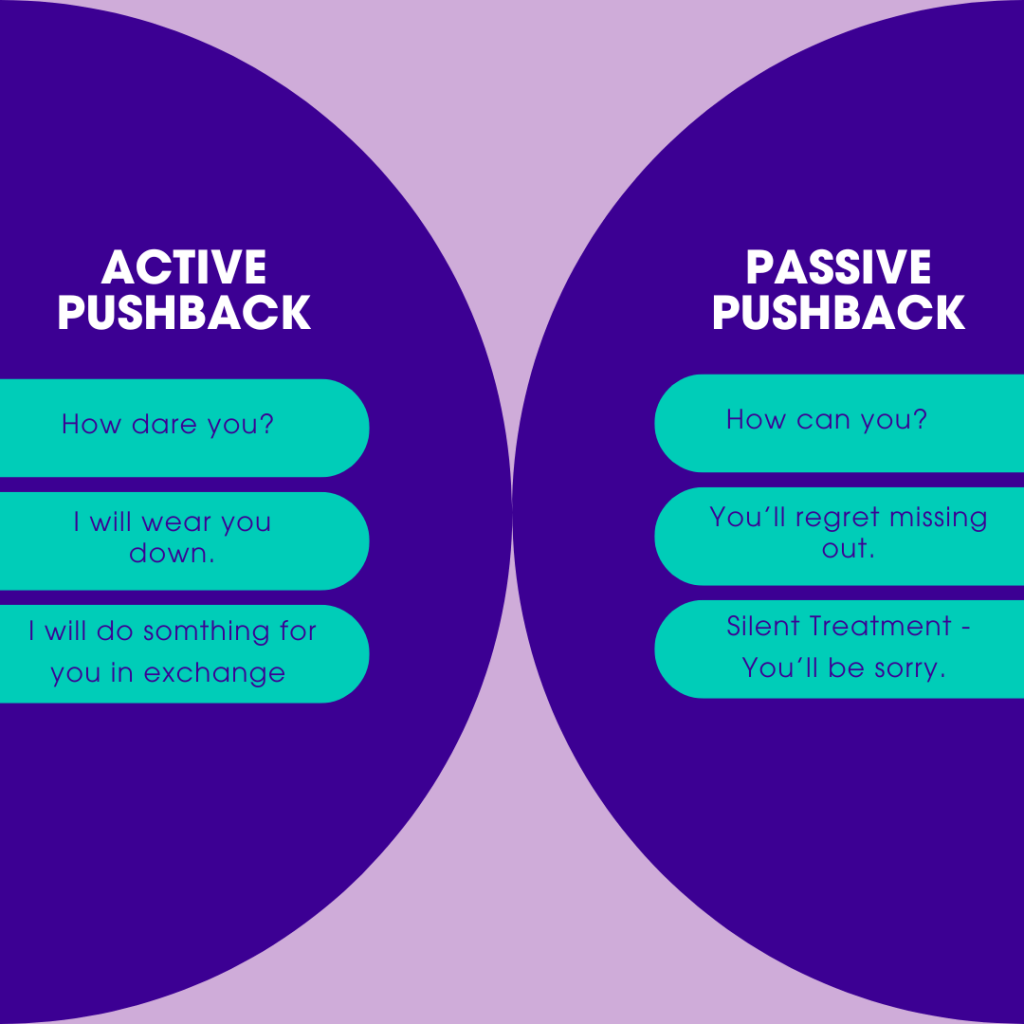
Active Push back:
Here, walnut trees use their dominant position to put pressure on us to conform to their wishes
- Enraged “How dare you” – Responding with aggression and anger when we rightfully stand for ourselves, stems from the walnut tree’s belief that we are wrong in saying no.
- Insistent “I will wear you down” – When walnut trees use insistence, they turn a deaf ear to our protests and refuse to listen to our no. They tend to take an authoritarian stance, implying that they know what’s best for us and deny us our right to decide for ourselves
- Bargaining “I will do this for you in exchange” – Sometimes a walnut tree will use a refusal as an invitation to negotiate. They don’t see our no as a firm decision. Instead, they try to engage us in a dialogue and keep us invested in what they want.
Passive Push back:
Here the walnut tree subtly manipulates our thoughts and feelings, making us feel bad about saying no, so that we ourselves decide to change our minds
- Guilt Tripping “How can you?” – In this case, Walnut trees view our decision to say no as morally wrong. By treating our refusal as a transgression, they make us feel guilty about our decision and encourage us to repair our wrong doing and comply with their request.
- FOMO “You’ll regret missing out” – FOMO (fear of missing out) taps into our human need to belong and our desire to stay connected with others and participate in social activities and events. Walnut trees can be astute exploiters of FOMO. They will try to make us look outwards and think about what we might be missing out on rather than letting us look inside and decide what is right for us to do.
- Silent Treatment, “You’ll be sorry” – An ominous, stony response to our refusal is almost as intimidating as outright yelling. Walnut trees might display this response as a warning of the disaster that will befall us if we persist in our position of saying no. They want to create doubt and uncertainty in our mind about the decision we have taken.
With so much negativity and manipulation, we’d rather have a magic wand that makes them disappear. Since that is not possible, let’s look at ways to say an empowered no and manage pushbacks.
“We can either make ourselves miserable, or we can make ourselves strong. The amount of work is the same.” – Vanessa Patrick
Saying an Empowered “No”
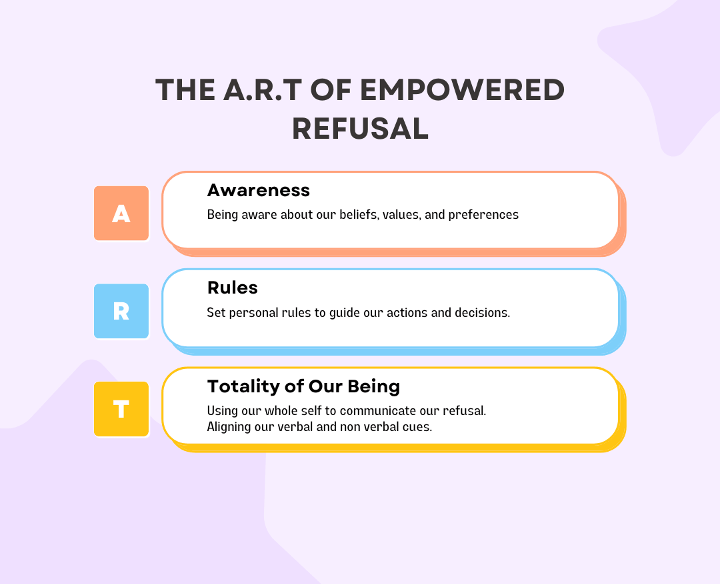
Having conviction in our stand and our reasons for saying no can help us go a long way in avoiding the “obedience” spell. Vanessa shares the A.R.T framework to say an empowered no.
- Awareness – Empowered refusal begins with self-awareness. What are our preferences, beliefs, and values? Knowing this will give us conviction in the face of a pushback and make our no more impactful
- Rules – Setting up simple rules to guide our actions and decisions make it much easier to say no. People are less likely to push back when we say we “don’t” do something(rooted in rules) versus when we say we can’t do it (opens up your decision for debate).
- Totality of our being – Using our whole self to communicate our refusal. Aligning our verbal and non verbal cues.
In addition:
- Remember, it’s them not us – We need to remind ourselves that the pushback has little to do with us. It’s about the walnut tree not us. It’s their misplaced perspective and attitude that doesn’t allow them to accept our refusal.
- It’s expected – In the course to charting our ambitious journey, we will meet walnut trees and will receive pushback. Normalising it and looking at it as a challenge to overcome lessens some of the negative emotions that accompany pushback and aids in our quest for personal mastery.
Managing Pushbacks – Responding with strength and grace.
Reinforcing our position to respectfully stick to our decision
- Spelling it out – If our empowered no is falling on deaf ears, we need to spell out how being pushed hard makes us feel. “I have already told you where I stand. Please respect my decision.” Or Please don’t keep on asking. All you are doing is making me say no five times instead of just once.” Or “its making me very uncomfortable to have to keep saying no to you” or “If I change my mind, I will let you know”.
- Stating our personal policy – Got a colleague trying to guilt trip you into taking on a project that won’t fit your calendar? State your policy e.g. “I don’t take on new projects until I complete what I already have on my plate”
- Pre-empt requests from walnut trees – If we know that we will get a request to take the red eye flight, can we consider pre-empting it by submitting travel request before hand taking day time travel in account? Or discuss the prioritisation of work with our manager beforehand so that when he / she gives us more tasks to do, we can refer to the priority list?
Creating distance between us and the walnut tree’s toxicity
- Buying time – A walnut tree will often put us on the spot and expect an immediate “yes.” Making it a personal policy to never say “yes” on the spot and buying time helps us avoid the trap.
- Delegating our no – If we are in a leadership position, we can consider delegating saying “no” to someone. It’s quite common for leaders to maintain a friendly stance (good cop) while having someone else in their office to say “no” (bad cop)
- Using Technology as a buffer – We can use technology as a buffer if the request comes to us through email, text or social media. This takes the pressure off face-to-face interaction and gives us time to draft an appropriate response to the ask.
Conclusion
We need to become adept at understanding the agendas of others, the way bullies operate, and learn to see through manipulative tactics, even though they might be couched in praise and flattery.
Doing the inner work to understand our values and principles will work as a compass when manipulators confuse and disempower us. Working with a coach to do this inner work or to create an intervention in a potentially toxic situation can take us far.
“Individuals who allow unnoticed or uncontrolled invasions of their internal psychological world, and consequently changes in their behaviours, do not survive and prosper.” – Marian Friestad and Peter Wright.
Resources to explore
- The Power of Saying No – Podcast with Vanessa Patrick on Spotify and Apple Podcast
- The Power of Saying No – Book by Vanessa Patrick
- Find a coach on Bridge to Leadership to help you deal with walnut trees
 Bridge to leadership
Leave a comment