
If you are a person obsessed with offering your best (I sure am one of them), then you are definitely in demand. However, to sustain your relevance, you will need more than top performance in areas where you are good at already. You will need to spend time learning new things. Especially things that you care about and those that will help you make an impact, even if they are not needed immediately.
However, donning the student avatar is easier said than done. After all, who wants to revisit the experience of being a novice and go through the discomfort that comes with it? Not to mention the risks involved with making mistakes. And what about reputation? I mean, who wants to make rookie mistakes when the world is used to seeing you as an expert?
And yet, it’s important to step into what Eduardo Briceño calls “the Learning Zone” in his Ted Talk.
Only by infusing your current expertise with newfound skills can you grow yourself and add value to your environment.
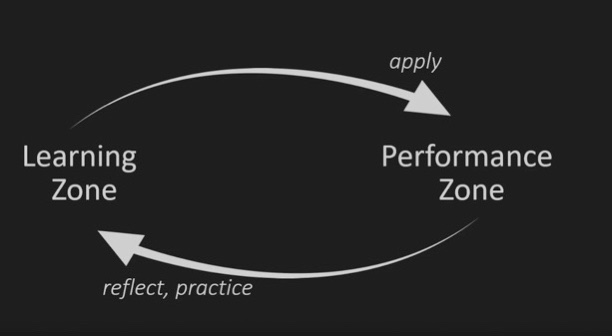
Source : Ted.com
- It’s important to distinguish the goals and activities of the two zones, else you might end up in troubled waters when the stakes are high or not experimenting enough when the stakes are low.
So how can you step into the learning zone, despite your defenses pulling you back?
| Learning Zone | Performance Zone | |
| Goal | Improve | Do as best as you can |
| Activities for | Improvement | Execution |
| Concentrate On | Haven’ mastered yet | Have Mastered |
| Mistakes to be | Expected | Minimised |
I have been guilty of bringing performance yard stick to my learning zone. For example, in most of my golf lessons in the driving range, I try to hit the ball as straight and far as possible. My coach asks me to focus on one aspect of my swing at a time, never mind if the ball doesn’t take off. Correcting that one aspect would improve the distance and direction of the ball consistently by manifolds. But since I am so embarrassed by imperfect shots, I almost always fail to make the most of my lessons.
- Identify or create low stake situations for yourself and your team
- Find a mentor or a teacher, who can be your sounding board and guide while you attempt something new
- If you are a team lead, try to do away with the “flawless execution” culture in the team. Assign a buddy to a team member who wants to learn something new. More important, learn to absorb the mistakes of your team.
- Communicate with your peers, team members and managers when you are shifting from performance to learning zone and vice versa. This will foster support and growth
- If you are a parent, don’t focus on the correct answer. Instead encourage your child to take you through his/ her thinking process, irrespective of whether it leads to the right answer or not
- Reflect and review
- Even if you are undertaking a high stakes project and in performance zone, review it at the end, to see where the scope for improvement is
- Apply the insights when you get the next opportunity
- Finally, avoid creating artificial high-stake situations for yourself and your team.
An endeavour to striking a balance between your performance and learning zone can do wonders for you. If you can be a novice again, live through your mistakes, improve consistently if only by a small margin, then before you know, you will be growing and improving leaps and bounds. Not to mention, the inspiration your will provide your team to step out of comfort zone and be brave. All without necessarily sacrificing performance and credibility.
Hope you embark on learning something new!
Cheers!
Resources to explore
- How to Get Better at Things You Care About – Ted Talk by Eduardo Briceño
- The Performance Paradox(How to learn and grow without compromising results) – Book by Eduardo Briceño
 Bridge to leadership
Leave a comment