
Here is a scenario from “How women rise” by Sally Helgesen and Marshall Goldsmith. “You are just starting a new job. It could be with a new company or in a new division of the company you joined ten years ago. You may be feeling a bit out of depth. You are a novice when it comes to certain skills. You don’t know how to get your hands on resources you need and aren’t sure whom to ask. Your boss seems friendly and well informed, but she’s in the middle of a hiring spree and you don’t want to pester her with questions. But you need to get up to speed quickly…..” What would you do?
If your plan is to focus on learning as much as you can by studying the masses of material HR has provided and immersing yourself in the details of your job; when you have a better handle of your job, you’ll put your head up and start building connections; then please DO NOT proceed. You are about to make a very common mistake many (not all!) women make.
Here is an alternative: how about you ask with the question, “who should I connect with to make this job a success?” View the path to success not as a matter of what or how, but a matter of who. See connections as an important part of your job and aim to start building them from day one. The result of this who centric approach? More support. Better Positioning. Greater visibility. Less isolations. And last but not the least, a lot less work.
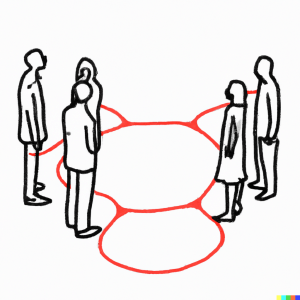
What makes an effective network?
According to Ibarra, there are three types of networks at play:
Operational Network – This network helps you manage current responsibilities. It includes your direct reports, your superiors, people in other units and key outsiders such as suppliers, distributors and customers. A good operational network gives you reliability. However, you have little or no discretion over this network.
Personal Network – Personal network is decided based on one’s personal goals and affinities. It includes people you are closest to – friends, family, trusted advisers, people you meet through professional associations, alumni groups, clubs and other personal interest communities. You have a lot of discretion over who is included in this network. A good personal network gives you kindred spirits.
Strategic Network – This network includes people and groups that can help you compete in the future. A good strategic network gives you connective advantage i.e the ability to marshal information, support or other resources from one of your networks to obtain results in the other. It’s not so much about the one – on – one relationships you have but its more about how they intersect.
Key Points to ensure you gain maximum leverage from your networks:
- Operational Networks are critical and most professional manager or leaders would invariable have robust operational networks to get their work done. However, this network doesn’t help ask the strategic and future focused question “what should we be doing instead.” Therefore, investing in strategic networks become crucial for impact, influence and growth as a leader.
- Personal Networks are often seen divorced from day to day work. It is imperative to look for synergies between personal, operational and strategic networks so that each circle enriches and strengthens the other.
- Strategic Networks can be tricky since it is not always obvious who should be a part of this network. A good way to judge is to look at the connective advantage. If having someone in your strategic network enables you to add value to others in your network, then by all means invest in that relationship.
Now that we know the building blocks of a sound network, here are three sources that lend advantage to your network:
How diverse is your network aka breadth of your network ?(B)– As a leader you are required to bring effective insights to your organization and teams. This is possible when you have an optimally diverse network. When I say optimum, it means you need to strike a balance between:
- Network inside and outside your organisation – Network outside the organisation enables leaders to tap into the best sources of insight into environmental trends. Strong networks within your organisation empower you to sell your insight/ strategy and ensure its implementation.
- Network with seniors and juniors in the organisation – Undervaluing the potential contributions of juniors in one’s organisations is a common blind spot. What makes managers invaluable to their seniors is their ties with the juniors in their team as well as the organisation. Senior leaders don’t need the managers to connect them with other seniors, they already know each other. Top management need managers to bring them the fresh ideas, insights and best practices that you can only get elsewhere, outside, across and below. A 360 degree perspective can only be attained from cultivating relationships with a mix of peers, juniors and seniors.
How connective is your network (C) – Your competitive advantage i.e. how you differentiate yourself from others who are as smart, hardworking or expert as you are – depends on your capacity to connect people, ideas and resources that wouldn’t normally bump into one another. Malcolm Gladwell in his book The Tipping Point coined the terms “connectors” for people with such capabilities. Connectors can see need in one area and solution in another, a vacancy in one area and a talented person in another, a discovery from different discipline and a problem in their own, and so on. To ensure your network offers you this competitive advantage, take a stalk of people in your network and see these people also happen to know each other. Or are their disjoint group of people who would link with each other through you? If you have a network where nearly everyone with whom you discuss important work issues knows each other, then you have an “inbred” network as Ibarra calls it. An inbred network doesn’t allow the advantage of access to fresh ideas or empower you to become a connector.
How Dynamic is your network (D) – As your career evolves so should your network, else it will stop serving you. “To make your network future facing, you need to value your weak ties…” says Ibarra. What makes these weak ties advantageous to you is that they come from outside your current world giving you a host of insights and synergies. To nurture this network, you need an explicit plan and strategy since they will not evolve naturally. You need to keep your own strategic concerns in mind while identifying the weak ties to nurture.
| Network Advantage (A) = Breadth of the network (B) + Connectivity of the network (C) + Dynamism of the network (D) |
Getting Started
Start on the periphery of your current network, and build outward by getting involved in new activities, asking the people you already know to connect you with others, doing some maintenance and finding kindred spirits who are also working to step up. Here are some practical action points:
- Show Up – Build on your interest or domains of expertise through professional associations, alumni networks, industry groups etc.
- Use projects and assignments strategically
- Invest in extra curricular activities
- Create your own communities of interest
- Use lunches and business trips to connect with people you don’t often see
- Favour active rather than passive networking opportunities (e.g don’t just show up for events – organise or speak at them)
- Use social media to broadcast your interests and cast a wider net to people who share them
- Use your two degrees of separation – Good networkers are aware of and use their degrees of separation, reaching out regularly to their contacts’ contacts and even to their third-degree contacts. Great Networkers decrease the degrees of separation between their contacts and people they don’t know but who might be useful to them. They add value by enlarging others’ networks.
- Ask for referrals and introductions, make them to others
- Ask for simple favours to initiate a relationship
- Do your homework before you reach out to someone new
- Do the trite stuff – write thank you notes, forward links to articles, follow up using social media
- Help your contacts develop their networks
- Do some maintenance – Don’t wait until you really need something badly to reach out. Instead take vey opportunity to nurture your network, whether you need it now or not.
- Find kindred Spirits – The fastest way to change yourself is to spend time with people who are already the way you want to be. This is so because you don’t just need to change your behaviour. You also need to change the reference by which you judge what is possible and desirable. Therefore sustain regular social contact with people who are on the same boat or have already arrived on the other side. As you attain senior levels and broader responsibilities, you are easily isolated from these kinds of collegial and peer relationships. For this reason, you usually need to build these relationships outside the scope of your job and company.
Sources :
Act like a leader, think like a leader – Hermia Ibarra
How women rise – Sally Helgesen and Marshall Goldsmith
 Bridge to leadership
Leave a comment